One of the quotes I hear frequently regarding any sort of data is “trust but verify.”
With the advent of artificial intelligence, the widespread use of social media, and a general lack of proper education, it’s getting harder and harder to tell when someone is accurately representing a vehicle for sale. Kevin Marti of Marti Auto Works recently posted a thoughtful reminder about being mindful about AI. Kevin said, in part:
“A few days ago, someone contacted us about their special vehicle. He sent a statement about some information he ‘found.’ I guess the belief was that we would just take that at face value and do as we’re told. Reality doesn’t work that way …
Someone believed they had the highest serial number 1969 Shelby. And AI let them know that was “true.” Now they contact us for confirmation. We’re actually not doing that any more.
Why? Because people shoot messengers. Each time we give someone the bad news, somehow, we’re at fault. Not their unrealistic expectation, not their false hope, not the AI machine that hallucinated the whole thing. It’s our fault … I can almost smell the snake oil.”
Be careful about asking AI about production statistics, rarity, desirability, and collectability of automobiles. The tool is fed by information gathered around the internet — sometimes from less-than-reputable sources, and frequently without any citations at all. Artificial intelligence may even be completely out of touch with things like rudimentary trim tag decoding.
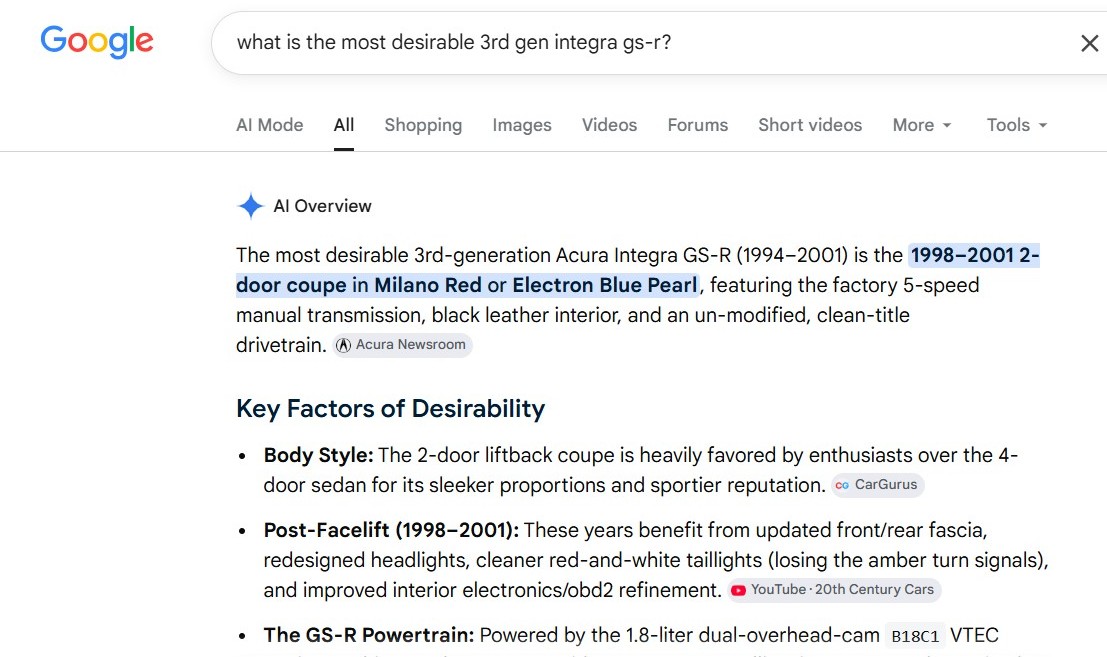
Check out the below image. I asked AI what the most desirable third-generation Acura Integra (1994-2001) model is. It gave me a response that mentioned the color Electron Blue Pearl. But as almost any obsessive Honda enthusiast could tell you, Electron Blue Pearl wasn’t even offered on the Integra. It was a color used for to the similar-year Honda Civic Si. The Integra variant was called Super Sonic Blue Pearl.
The same caution goes for photographs: while it’s okay and even appreciated for a seller to optimize a photo for lighting, cropping, and clarity, it’s easy for some to get carried away with backgrounds and filters, leaving things feeling less “authentic.” That leaves sellers at a risk of misrepresenting, and buyers at risk of misinterpreting, what is actually for sale.
While artificial intelligence can certainly be a great resource for car enthusiasts (regarding do-it-yourself mechanical tasks, for example), it is a dangerous place to be looking around for information about vehicle specifics.

There are over 31,000 vehicles at your fingertips on the ClassicCars.com classifieds, and there is nothing that we want more than to be the perfect matchmaker between seller and buyer.
But it’s going to take everyone’s help to make sure every seller is as forthcoming as possible and every buyer as diligent as possible when it comes to being smart about AI-related pitfalls.