For last week’s “Settle The Debate,” I invited you to vote for which striped and spoilered muscle car did it best. This week, we look back to the early 1990s at “sport trucks” to see which one you would purchase. What will it be? Are you going to go with the Ford, 1991 GMC, or 1990 Chevrolet? Money is no object, so the choice is yours.
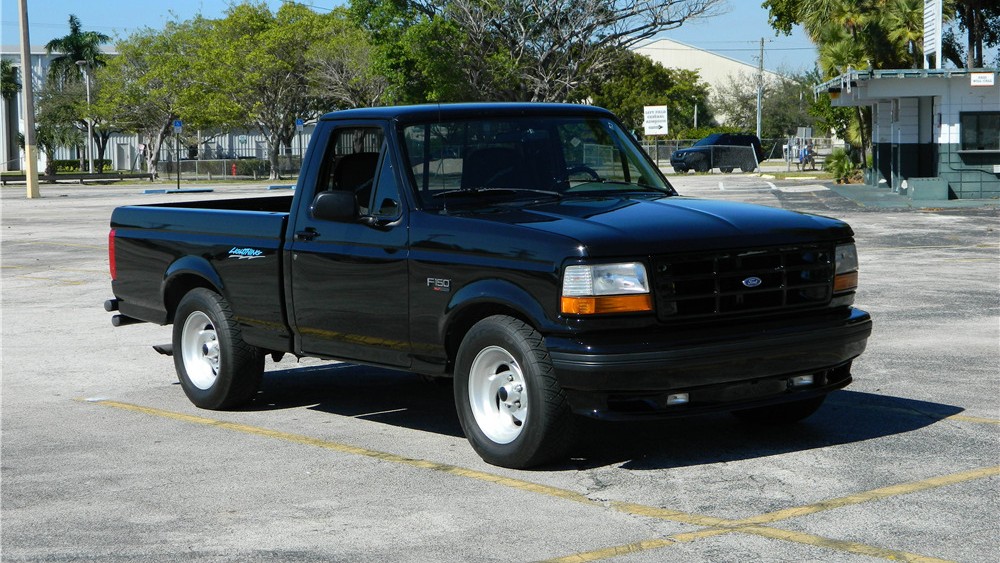 Image courtesy of Barrett-Jackson
1993 Ford F-150 Lightning — The first-generation Lightning was powered by a 5.8-liter V-8 upgraded by Ford’s Special Vehicle Team (SVT). It included GT-40-type cast-iron cylinder heads, tuned intake manifold, high-rate fuel pump and injectors, and redesigned air filter. With tubular stainless-steel headers and full-length stainless steel dual exhaust system, the Windsor small-block was rated at 240 horsepower and 340 lb-ft of torque. The only transmission available was an electronically controlled E40D four-speed automatic recalibrated by SVT; an auxiliary oil cooler also was used. Out back, the power is handled by an 8.8-inch rear with 4.10 gear, limited-slip differential, and Lightning-specific housing with external cooling fins. There were only 5,276 of these bad boys built for the 1993 model year, with 2,691 offered in Raven Black and the rest offered in Bright Red — both without clearcoat, 11,563 were built through 1995. In case you’re curious if the 1993-1995 single-cab F-150 you are looking at is the real deal, you’ll find an “R” in the eighth character of the VIN noting the Lightning-exclusive V-8.
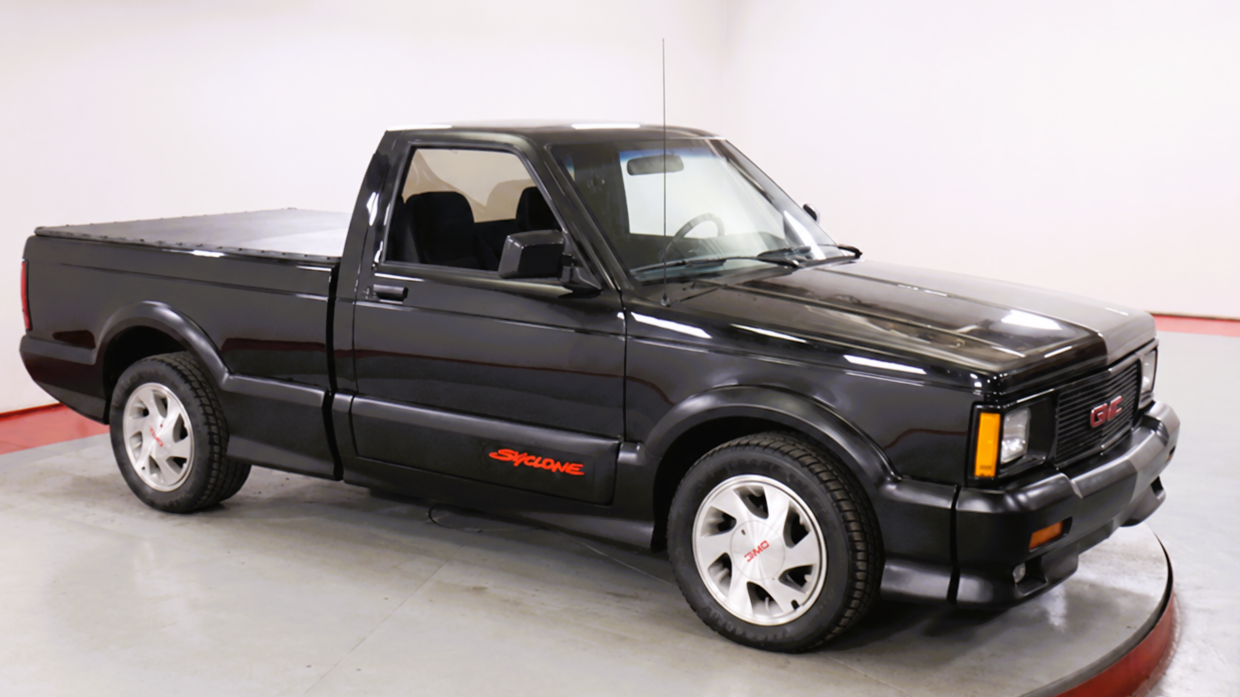 To view this 1991 GMC Syclone listed for sale on ClassicCars.com, click the above image.
1991 GMC Syclone — This Sonoma-based performance pickup was powered by a turbocharged 4.3-liter Vortec V-6 with port fuel injection. Rated at 280 horsepower and 350 lb-fr of torque, this engine was factory-modified with lower-compression pistons, special intake and exhaust manifolds, twin-bore throttle body (sourced from the Corvette), Mitsubishi TD06-17C turbocharger, and Garrett water-to-air-intercooler. The upgraded Vortec was mated to a four-speed automatic transmission that included a torque converter clutch and lock-up overdrive. Obviously, the Syclone was meant as a performance street truck and not one to be taken romping in the desert, though GMC engineers included a transfer case. Instead of transferring power equally to all four wheels like standard four-wheel-drives, the transfer case splits the torque 35 percent to the front axle and the remaining 65 percent to the limited-slip rear differential with 3.42 gears. There were only 2,998 Syclones produced, which included three 1992 pilot models. According to the International Syclone Typhoon Registry, the VIN must begin with “1GDCT14ZXM880” to identify it as a true Syclone.
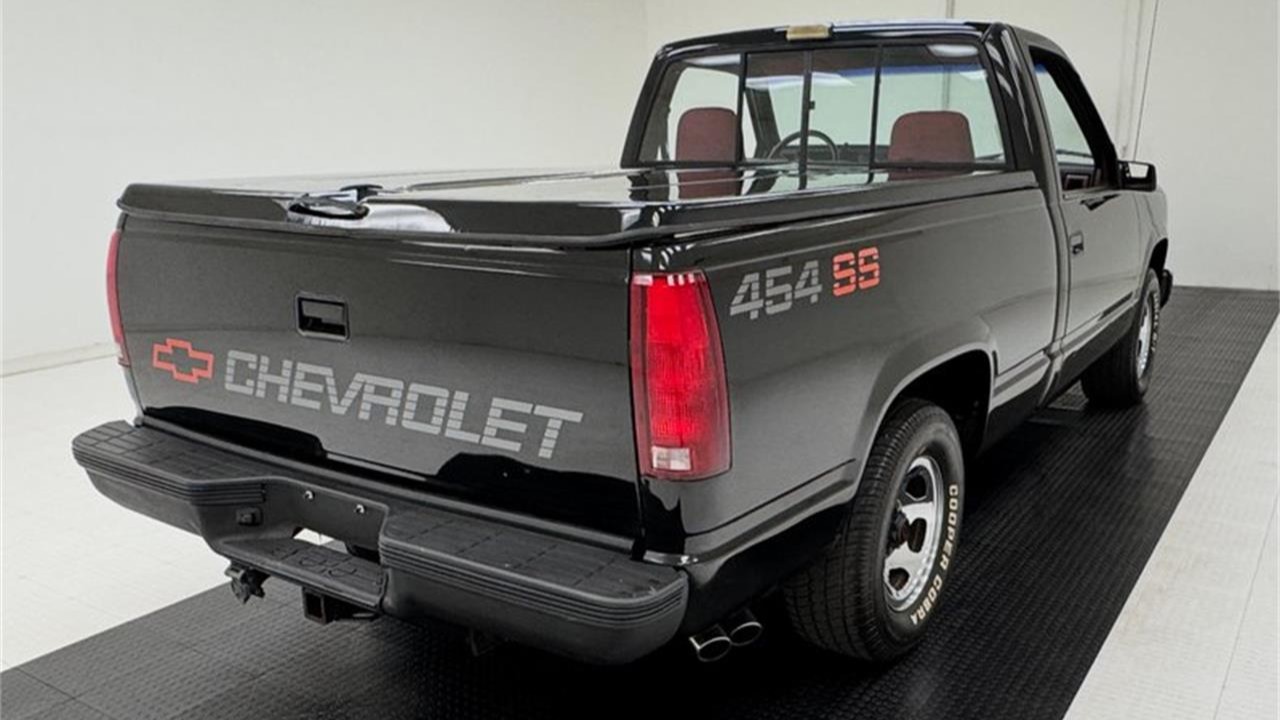 To view this 1990 Chevrolet 454 SS listed for sale on ClassicCars.com, click the above image.
1990 Chevrolet 454 SS — The 1990 brochure asked, “Are you ready for this much truck?” The new 1990 Chevrolet 454 SS was based on the C1500 regular-cab pickup packing a 230-horsepower 454ci V-8 (255 horses starting the following year) with 385 lb-ft of torque, mated to a three-speed TH400 automatic (4L80-E 4-speed automatic, again the following year). Equipped with the Performance Handling Package, locking rear differential with 3.73 gears, and Bilstein shocks, Chevrolet ensured its new sport truck would be more than capable beyond its substantial torque. For its first model year, the 454 SS was produced exclusively in Onyx Black with matching blacked-out grille and contrasting chrome-plated wheels. From 1990-1993, Chevrolet built 16,953 454 SS pickups, with the majority being the ’90 with 13,748. There are two ways to tell if what you’re looking at is a true 1990 454 SS: The first is to see if there is an “N” in the eighth position of the VIN, and the second is to discover if the RPO code B4U is present on the Service Parts Identification label stuck to the inside of the glove box door.
Which sport truck would you purchase? Or would you rather build your own? Tell us in the Comments section below.