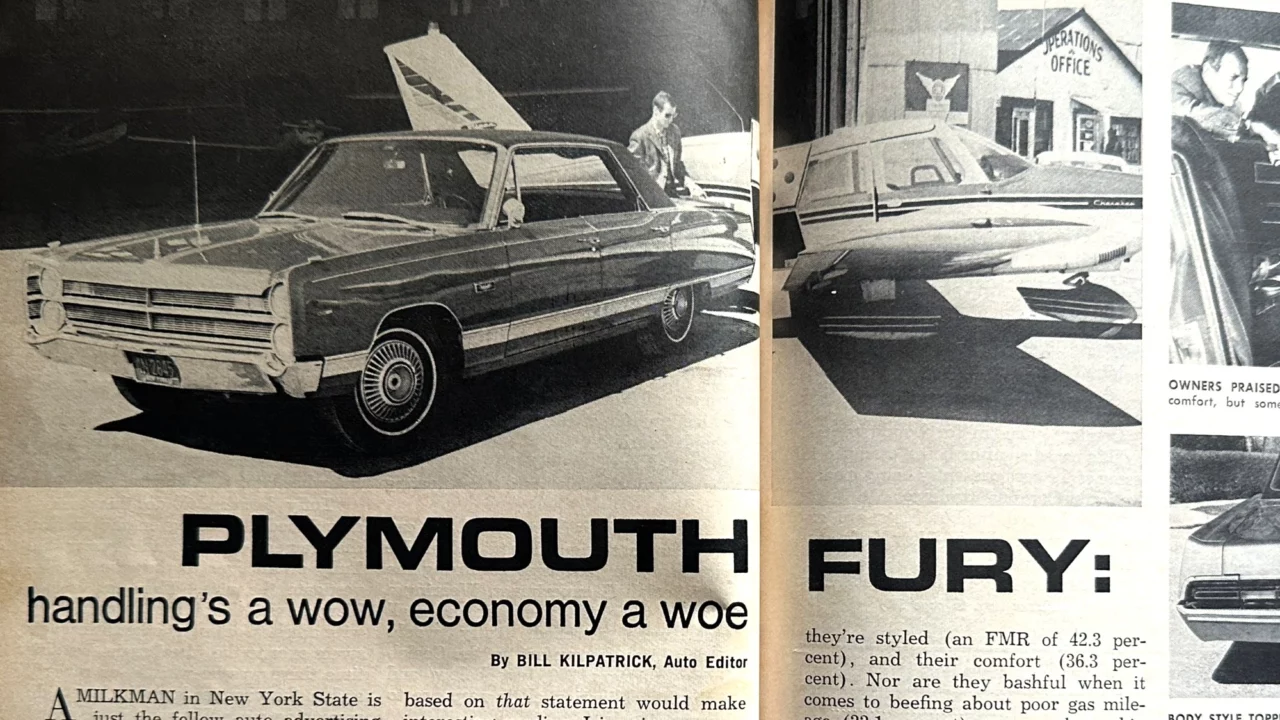
Popular Mechanics magazine was keen on assessing consumer satisfaction with new cars. I recently shared a story about an owner survey that was conducted among first-year buyers of the new 1967 Chevrolet Camaro. A similar analysis was put together by editor Bill Kilpatrick regarding the 1967 Plymouth Fury.
Starting in 1965, the Fury rode on Chrysler’s full-size C-body platform, and within the Fury lineup were various trim levels. The scope of Popular Mechanics’ survey included feedback that was collected from owners of Fury I, II, III, Sport Fury, and VIP.
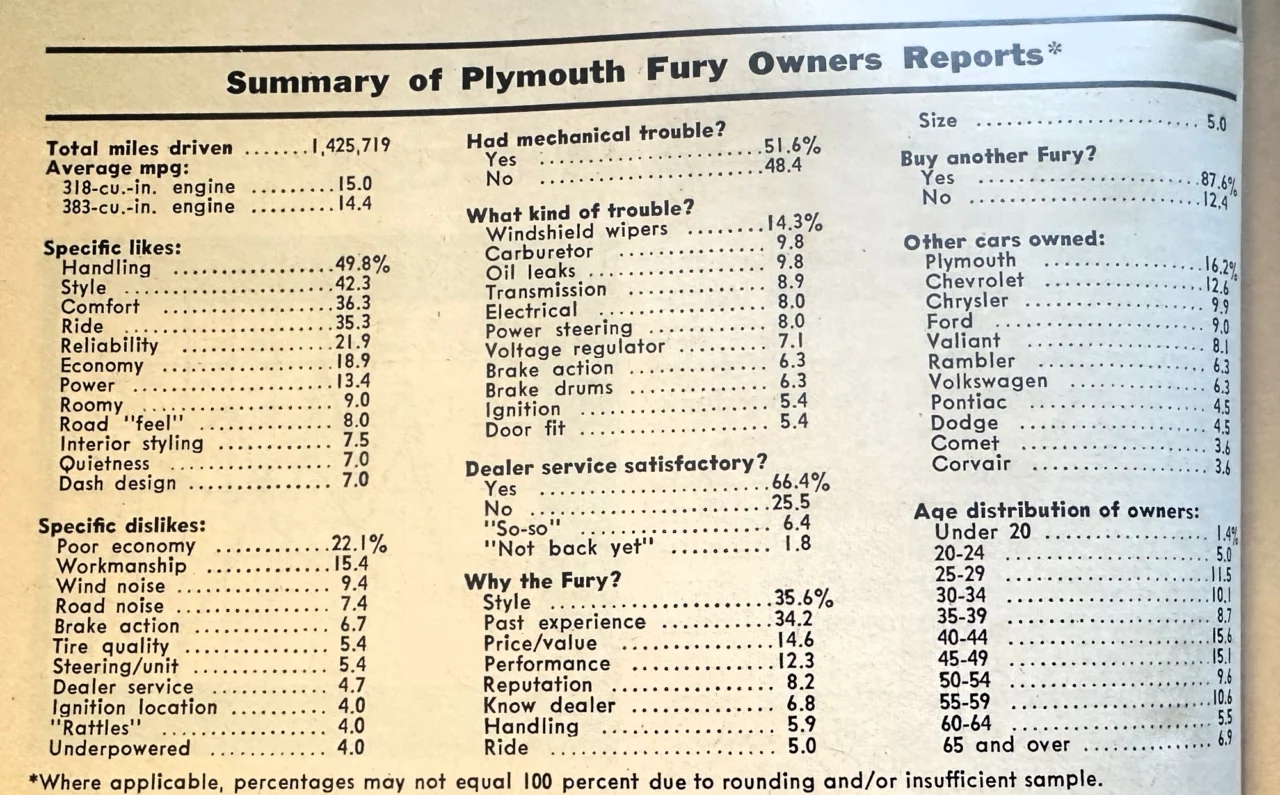
Collectively, respondents to the survey (which was published in July 1967) had driven 1,425,719 miles. Highly-rated features (and associated FMR, or Frequency-of-Mention Ratings) included:
- Handling at 49.8 percent
- Styling at 42.3 percent
- Comfort at 36.3 percent
There also were plenty of complaints to be heard, too, most notably about the car’s fuel economy — the FMR rating was 22.1 percent. Other noteworthy mentions in the summary were poor workmanship (15.4 percent) and wind noise (9.4 percent).
In regards to fuel economy, two of the comments that Kilpatrick quoted in his article were, “My Cadillac gets better gas mileage than the Fury” and “My Fury uses more gas than my six-cylinder Ford.” Average miles-per-gallon were noted as 15.0 for the 318ci V-8 and 14.4 for the 383ci V-8.
Build quality was a point of concern that was brought up fairly frequently.
Would survey responders buy another Fury? About 87 percent of people said yes despite the car’s aforementioned shortcomings.
When compared to the previously-shared 1967 Camaro survey results, which demonstrated a very young buyer population, the age spread of Fury owners was more diverse — and much older:
- Age 40-44: 15.6 percent
- Age 45-49: 15.1 percent
- Age 25-28: 11.5 percent
- Age 55-59: 10.6 percent
- Age 30-34: 10.1 percent
This makes sense, because the Fury and Camaro were targeting completely different segments. Fury was a mainstream vehicle all about value and, on some higher trims, even a dash of luxury.
Kilpatrick ended his story with a quote from a New York salesman: “It’s a big car for the price. Beyond that, you’re on your own as well as how well it serves you.” Several respondents talked about having to take the car to the dealer multiple times to get any work done.
Some 60 years after the story was published, I wish Popular Mechanics had the ability to contact the original owners (or their families) to see how long they kept their Plymouth. And, are any of those Furys from the original dataset still on the road today?