Last year marked the Genesis brand’s 10-year anniversary. Hyundai’s high-end corporate cousin started off by making luxury sedans, but it wasn’t long until it released its first SUV, the 2021 GV80. Genesis soon followed that with the smaller GV70, which it called “athletic and sporty.” Several years ago, I spent a week testing out a 2022 GV70 3.5T Sport Prestige AWD and found it to be pleasant and well balanced, though not particularly thrilling on winding roads. For 2026, the GV70 receives a mid-cycle refresh that brings exterior styling tweaks and new tech, but one major thing remains the same after all these years.
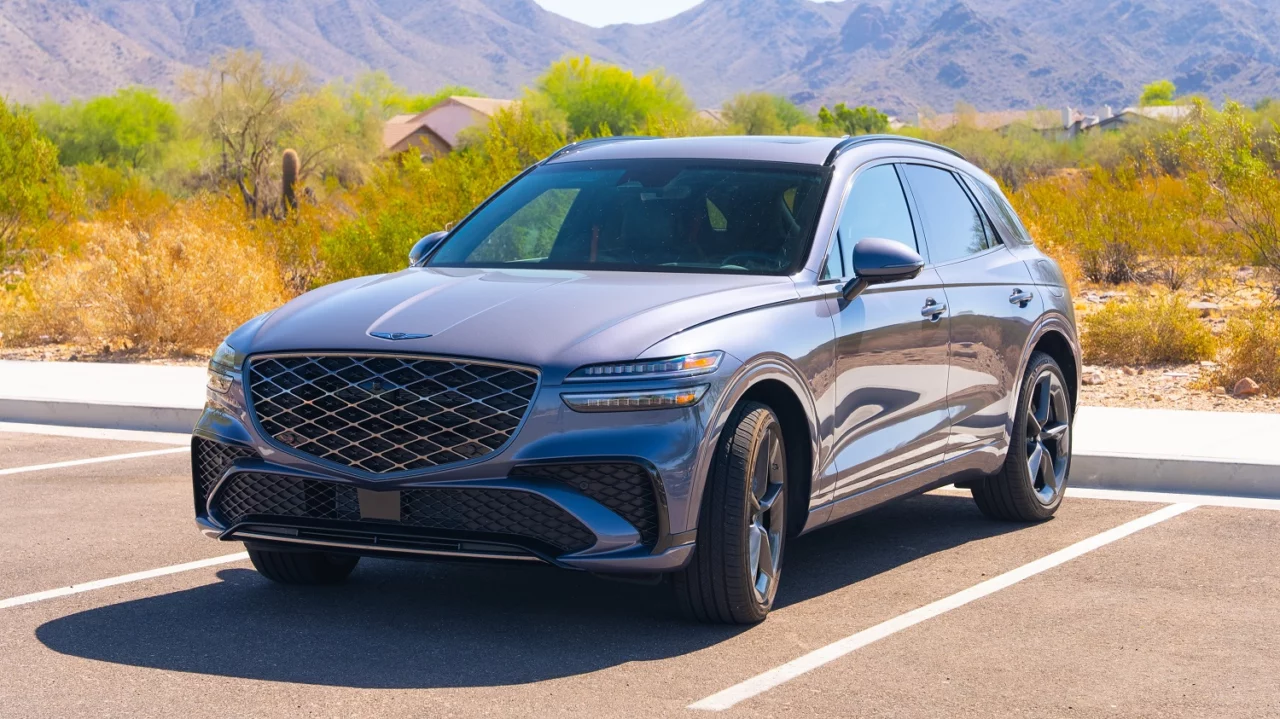
Given that many Genesis vehicles were launched only a few years ago, the automaker is now in a major renewal phase. Last year, it updated the G80 sedan and GV80 SUV (click the links for our reviews of both). This year, it’s the GV70’s turn. The new front end features a restyled G-Matrix Crest Grille flanked by two-line headlamps equipped with micro lens array (MLA) technology, essentially a compact unit capable of projecting a tightly focused beam of light. Wider air intakes and a more visually pronounced skid plate make the GV70 appear broader and somewhat tougher. The distinctive “Parabolic Line” gradually curves downward above the new 19- and 21-inch wheel designs. At the rear, more angular exhaust outlets replace last year’s round ports.
The most obvious difference inside the GV70’s cabin is the new 27-inch OLED display that combines the digital gauge cluster with the infotainment screen in one broad panel. What’s harder to see are the enhanced voice recognition controls, improved over-the-air update capabilities, and standard adjustable ambient lighting.
Whether you opt for the turbo four-cylinder 2.5T or the twin-turbo V-6 3.5T model, Sport Prestige AWD is the top trim level. My tester combined the best of both worlds and came with a long list of standard features that included 21-inch wheels, head-up display, 16-speaker Bang & Olufsen sound system, panoramic sunroof, microfiber headliner, Nappa leather upholstery, heated and ventilated front seats, heated rear seats, and manual rear side sunshades. Safety and driver assistance features ranged from those that help you avoid forward, blind-spot, rear cross-traffic, and parking collisions to those that assist with following and staying in your lane.
Aside from premium paint and accessories, there aren’t many extras you can add to the 3.5T Sport Prestige AWD. According to the window sticker, my test car had an MSRP of $70,095; the addition of the $650 purple-grayish Ceres Blue paint, $30 NFC key card, and inland freight and handling charges brought the total price up to $72,225. The EPA’s calculations showed it was capable of returning 18 miles per gallon in the city, 25 on the highway, and 21 combined. My colleagues and I racked up 432 miles and averaged 20.4 mpg.
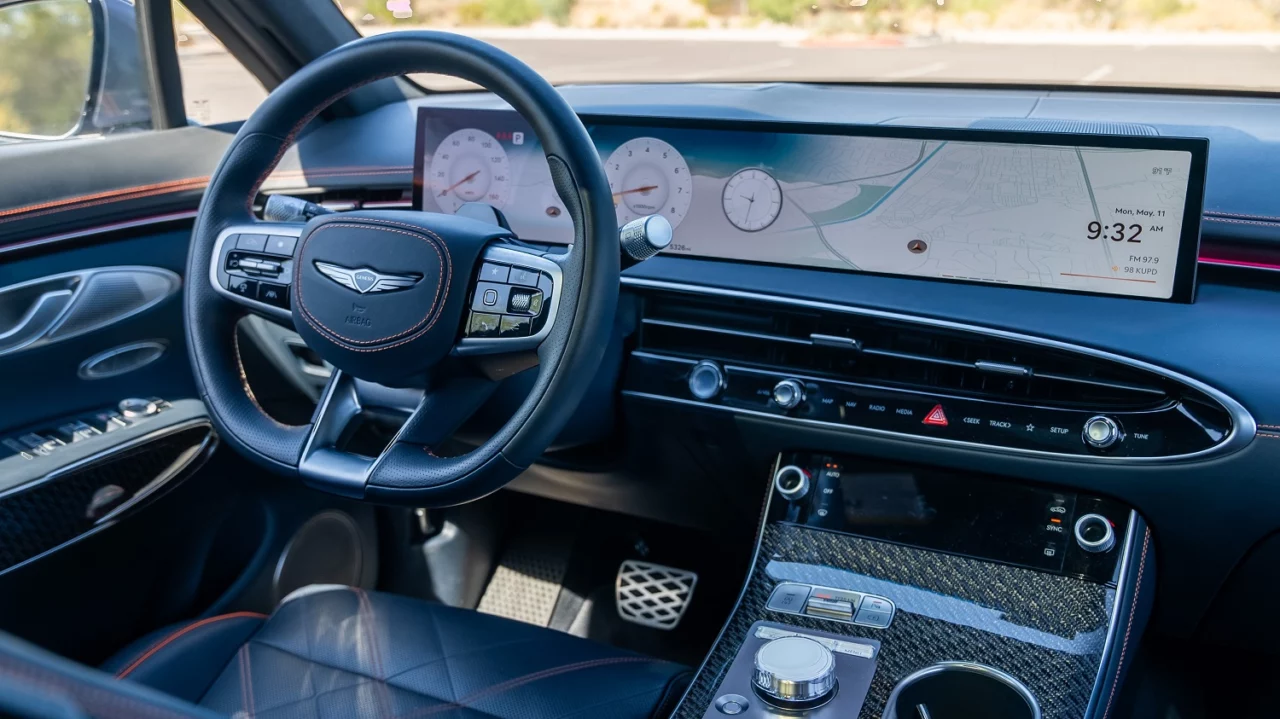
Genesis vehicles have had the same general look for several years now but, despite their familiarity, all of them (including the GV70) have aged well. The GV70 didn’t seem dated before, yet the ’26 updates help it stay looking slick and current. Its Ultramarine Blue interior with orange piping, stitching, and even seat belts can be seen as an acquired taste, but it only reinforced the fact that the GV70 feels and looks like an authentic luxury vehicle inside. When you pay over $70,000 for a vehicle that competes with offerings from BMW, Mercedes-Benz, and Audi, you should expect its cabin to offer upscale materials and options. The GV70 delivers both. Most of what you see or touch is Nappa leather, glossy carbon fiber, metallic trim, or fine, suede-like microfiber. As I mentioned earlier, the Sport Prestige AWD model is loaded already, but you can choose whether you want a more conservative color palette, such as Obsidian Black or Vanilla Beige/Obsidian Black, or something a little more bold and fun — in other words, Ultramarine Blue (note: the online configurator shows all of those colors are paired with orange piping, stitching, and belts).
Now that I’m both a husband and a father, I’m more aware of the GV70’s rear seating accommodations. On the weekends, my wife Eli, son Hayden, mother-in-law Liz, and I travel together. Typically, Eli rides shotgun while her mom sits behind me and Hayden rides in his rearward-facing car seat behind Eli. At full tilt, car seats can take up a lot of space and cut into the front passenger’s legroom; at five-feet-eight-inches, Eli could have been happier with a little more space up front, but she certainly had more room than her Mazda CX-5 provides.
Electric slide and tilt controls for the front passenger seat, accessible from the second row, made loading and strapping in Hayden’s car seat quicker and easier — a great combo when it’s summer in Arizona. Ceiling-mounted HVAC vents would have been ideal for my little guy, but there was a pair of them at the rear of the center console to pump cool air into the second row. Liz was grateful for the third climate zone, ample legroom, and manual side sunshades, as well as the ability to recline her seat.
Hayden is at the age where he’s walking all over the place, but we still travel with a compact stroller. To my surprise, I was able to lay that completely flat in the space between the rear wheel wells yet still have plenty of the cargo area’s 28.9 cubic feet of space left over — a little of which my family and I used to carry Mexican food leftovers home from El Encanto in Cave Creek.

During that 45-minute drive (and my equally long daily commutes), the GV70’s Comfort drive mode was appropriately gentle, but it was a little too soft and relaxed. The Sport setting pulled some of the slack out of the line and made the ride feel more composed; its livelier throttle response was a nice bonus. During a solo drive on my favorite testing route, I fully exploited both the Sport and Sport+ profiles. Even though many vehicles passed the 400-horsepower threshold long ago, the 375 horsepower and 391 lb-ft of torque from the GV70’s 3.5-liter twin-turbo V-6 didn’t feel out of date. When the boost hit and the eight-speed automatic sent the forced-induction power through the all-wheel drive system, the GV70 pulled with a satisfying force and urgency. But that was as sporty as it got. Everything around the engine felt less enthusiastic and communicative. Even in Sport+, the steering didn’t provide much feedback — and the associated feeling of engagement. The pedal connected to the 14.2-inch front and 13.6-inch rear ventilated brake discs was just as vague, feeling spongy at first push. Fortunately, once I reached the bite point, the brakes were easy to modulate after that.
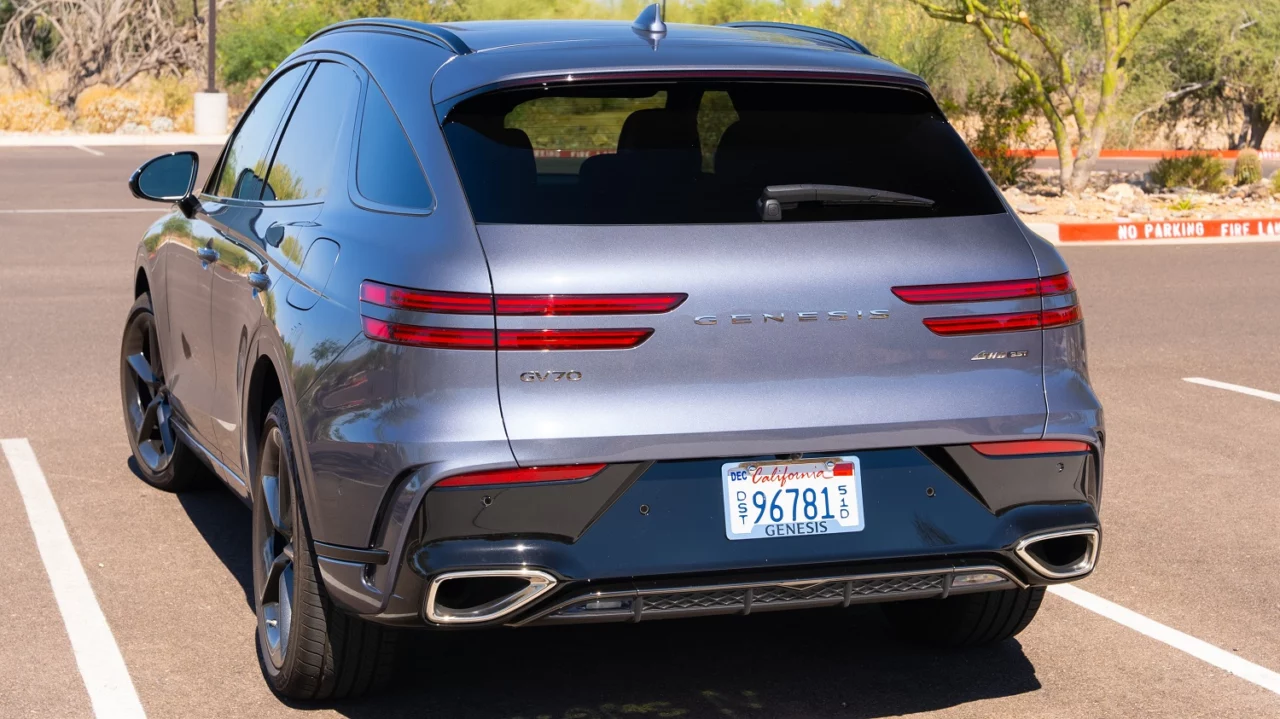
The 2026 Genesis GV70 may look a little different and have a flashier infotainment setup than its predecessors, but none of those updates fundamentally change it. Just as before, it’s an attractive, well-furnished luxury vehicle with plenty of power. It puts a smile on your face in several ways, but not when you find out just how “athletic and sporty” it is.
My colleague Luke also spent time in the 2026 Genesis GV70 3.5T Sport Prestige AWD. Check out his video review below.
Click above to watch our full video review on YouTube!