When I was a kid, I hated going with my father to home improvement stores. The smell of lumber and concrete floors inside a Furrow’s, McCoy’s, Home Depot, etc. always bummed me out and made me wish we could go somewhere that sold toys. I never had an interest in building materials, but that changed in 2015 when I saw that the National Corvette Museum (NCM) was selling bricks from the Flint, Michigan plant that manufactured the 1953 Chevrolet Corvette.
Over the past 73 years, “America’s Sports Car” has been built in three facilities. The first was in Flint. The second was in St. Louis. Since 1981, the third has been in Bowling Green, Kentucky (the same city that’s home to the NCM). All 300 of the Polo White 1953 Corvettes were hand-built in the Flint factory, but production was moved to St. Louis for the ’54s. With a Blue Flame I-6 and a Powerglide two-speed automatic, those early models were far from the performance cars we know Corvettes to be now, but steady improvements over the years (such as small-block V-8 power, fuel injection, fully independent suspension, and disc brakes) has helped the Corvette endure.
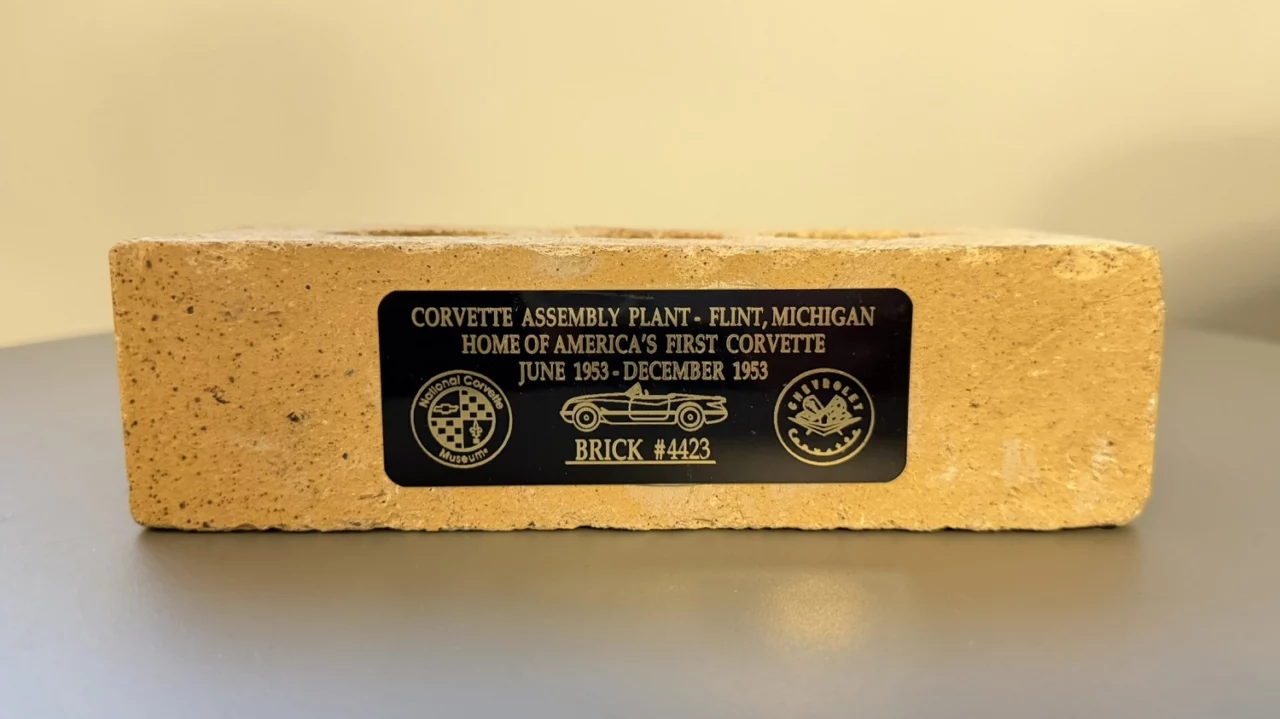
Unfortunately, the Flint facility that cranked out the initial run of Corvettes did not. In 2003, it was demolished by a wrecking ball. Twelve years later, the NCM started selling bricks from the birthplace of the Corvette for $25, each fitted with an individually numbered plate and accompanied by a certificate of authenticity. Plain, unnumbered bricks were only $5. At the time, I had better things to spend my limited funds on, so I restrained myself from buying the deluxe model. But I never stopped wanting one.
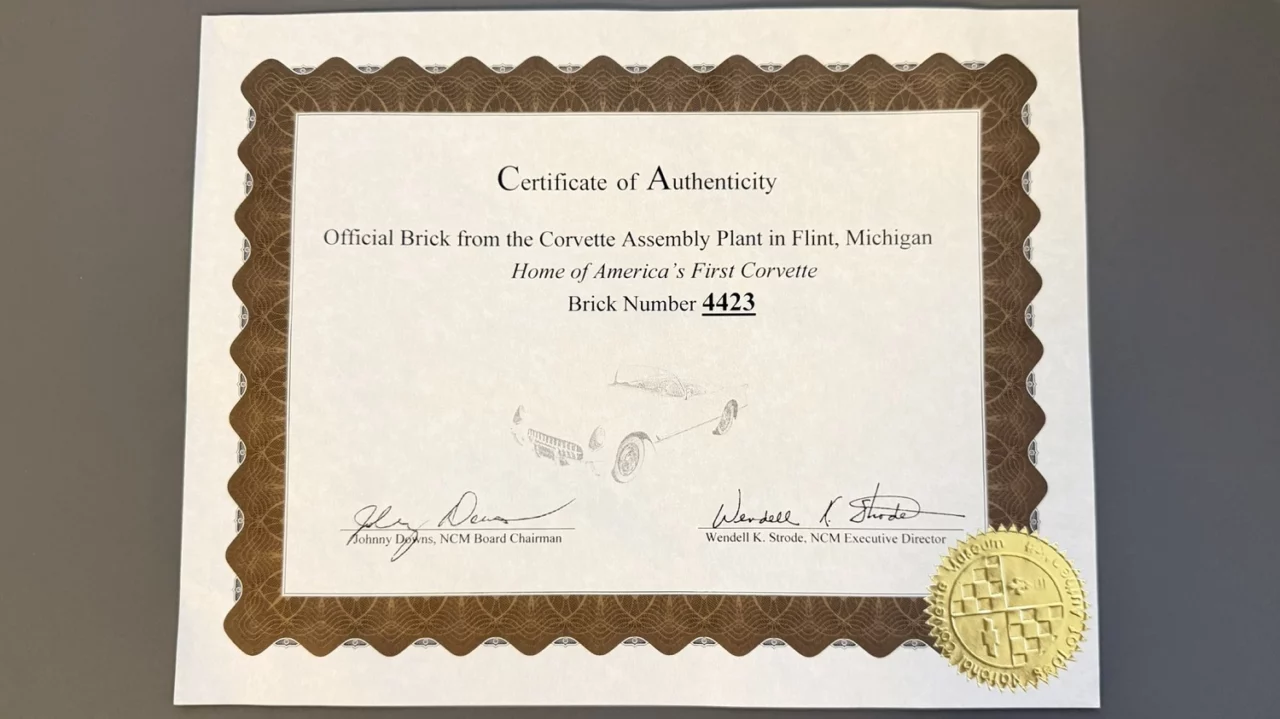
I finally scratched that itch a few weeks ago. How? With eBay, the same place where I scored my newest book, “Cord 810/812: The Timeless Classic.” Several days later, I received exactly what I expected from the seller’s picture: a brick with a metal tag showing that it’s Brick #4423, a Certificate of Authenticity with the same number plus an NCM foil stamp, signatures of Johnny Downs, NCM Board Chairman, and Wendell K. Strode, NCM Executive Director. One thing I didn’t anticipate was just how heavy the brick is! It has three holes in it, but it’s still hefty.
The older I get, the more automotive history fascinates me. It’s fun reading about it in books and brochures, but this brick is on a different level. It’s not just representative of an automaker’s past — it’s an an actual piece of it, a literal building block for one of the most beloved sports cars in the world.
Do you have one of the Corvette Flint factory bricks? In the Comments section below, tell us your brick’s number and where you display it (mine is on a book shelf in my office).